


|
Getting your Trinity Audio player ready...
|
Reputable private airline Goldstar Air, the belly of America and wings of Ghana’s 24-hour operations, represents a powerful initiative of what a New Ghanaian Economy will become: an Economy that does not pause when the sun sets, an Economy that moves goods, people, ideas, services, and opportunities across borders and time zones, and an Economy in which productivity is not limited to the traditional hours of the working day. The center of the airline’s initiative is the understanding that aviation is more than transportation. Aviation is a system of regional connection. It is a bridge between farms and markets, students and careers, tourists and destinations, manufacturers and suppliers, entrepreneurs and customers, communities and the world. Goldstar Air’s 24-hour operations is a system in which economic activities will create continuous demand for goods and services. The phrase “24-hour operations” is the New Economy and must not be understood merely as extending office hours or keeping airport lights on through the night. The airline initiative represents a deeper form of economic transformation. It also means building an environment in which cargo will move overnight, maintenance will be conducted after aircraft arrivals, hotels will receive international visitors at any hour, travel agencies will support customers continuously, cargo warehouses will process exports without unnecessary delay, digital platforms will serve users across time zones, and Ghanaian businesses will connect with global markets when demand exists rather than only when local offices are open.
The New Economy is not simply an Economy of more work. The Economy of smarter work, faster connection, stronger productivity, greater access, and better use of Ghanaian human and material resources all within 24 hours to achieve the airline’s Project $1 Trillion Foreign Reserve Goal. It is an Economy in which a farmer will harvest in the evening and have produce on a flight before dawn. It is an Economy in which a traveler arriving late at night will find safe transport, accommodation, food, and service. It is an Economy in which a young person will train for a technical career, work a professionally managed shift, earn a dependable income, and build a future. It is an Economy in which Ghanaian creativity, culture, products, and services will not be restricted by distance or delayed by outdated systems. The New Economy will be based on the idea that continuous aviation activity will stimulate demand around the clock and across many sectors, including tourism, agriculture, manufacturing, cargo, technology, hospitality, maintenance, food services, retail, creative industries, finance, training, and logistics. The New Economy is the 24-hour Economy that is set to generate direct and indirect employment opportunities, particularly for Ghanaian youth, and shows that the clock is racing ahead with full speed.
The United States and Ghanaian registered company Goldstar Air, with an Air Carrier Licence (ACL/N-SCH No. 0239) by the Ghana Civil Aviation Authority (GCAA) to operate passenger and cargo services across West Africa and on intercontinental routes. The airline is expecting the Director-General of the Ghana Civil Aviation Authority, Rev. Stephen Wilfred Arthur, to do the needful by tasking the Safety Department to get a qualified third party as a solution to finalize Goldstar Air’s wide-body aircraft Safety Certification (AOC) process immediately. The airline has secured incentives from major airports worldwide and has no liabilities as of today. Goldstar Air’s 24-hour operations is not merely about flying aircraft from one destination to another, but about unlocking a dynamic ecosystem that will interconnect numerous sectors. The Director-General of the GCAA must understand that any prolonged delay in Goldstar Air’s Safety Certification process represents an appalling injustice that has ruined lives, caused irreparable harm, disconnecting people from God, and a crime against humanity. He should remember that his church’s passion is to obey God, expand His Kingdom, and transform lives on earth through a dedicated life of holiness, worship, and love.
The Head Pastor of Kingdom Family International Church at Abeka Lapaz, who is also the Director-General of the Ghana Civil Aviation Authority, Rev. Stephen Wilfred Arthur, is fully aware of Goldstar Air’s wide-body aircraft Safety Certificate situation. The prevalence of nepotism and cronyism, including selective retirement ages within the Ghana Civil Aviation Authority, leads to corruption, wasting taxpayers’ money, willfully causing financial loss to the state, and sabotaging the government’s efforts of the Resetting Ghana Agenda to a New Economy, ultimately hindering the nation’s progress. The alleged attempted sabotage of Accra Airport safety equipment, which is critical to aircraft communication, navigation, and safe operation, during a planned strike by some Ghana Civil Aviation Authority employees between 11:30 p.m. on January 14 and 4:30 a.m. on January 15, 2026, was reportedly foiled by National Security officers and is part of the grand scheme and a common practice as a means of intimidating any government that comes into power. The Ghanaian youth cannot wait any longer in the ghettos; they need their well-paying jobs that will enable them to improve their lives and support their families, communities, and churches through tithes and other contributions.
The Director-General of the Ghana Civil Aviation Authority, Rev. Stephen Wilfred Arthur, must understand that his tenure as a union chairman is over and that he is now serving in a new role as the overall head of the Authority. It is also essential for a Director-General of any organization to step aside when continued leadership compromises organizational integrity, performance, or strategic alignment. Therefore, Rev. Stephen Wilfred Arthur’s persistent failure to instruct the Safety Department to engage a third party to finalize the airline’s Safety Certification process signals the need for a new leader and a normalization team. Development is built on trust, truth, and consistent action. An organization, or even a community, cannot grow when its words and actions do not match. This mismatch is called hypocrisy. Hypocrisy is the act of pretending to hold beliefs, virtues, or standards that one does not actually have or follow. When hypocrisy becomes common in institutions and society, it becomes a stumbling block that slows progress in every area of life. The foundation of any development is trust. Citizens must trust their leaders, workers must trust management, and partners must trust each other. Hypocrisy breaks that trust. When leaders preach discipline but practice corruption, or when institutions promote quality but deliver poor service, people lose faith. Once trust is lost, people stop participating. Investors withdraw, young people become discouraged, and communities stop working together. Without trust, no policy, no matter how good, can succeed.


Goldstar Air’s 24-hour operations will become a legacy of the airline, which is the New Economy, to replace the current administration’s 24-hour national momentum. The initiative will demonstrate that the airline is always prepared to compete in a world where trade does not sleep, digital commerce does not close, tourism follows global schedules, and international business happens across time zones. Goldstar Air will create an environment in which the country’s strategic location, youthful population, cultural strength, agricultural potential, entrepreneurial energy, and international relationships will be organized into a more productive whole. The aircraft will become the visible symbol, but the deeper transformation is in the network of people, businesses, communities, and institutions that will grow around it.
The importance of Goldstar Air’s 24-hour aviation operation begins with time. Time is one of the most valuable resources in the modern economy. A country will possess fertile land, talented people, valuable products, skilled workers, strategic geography, and ambitious businesses, but if it cannot produce products like the Komenda Sugar Factory, serve customers, process transactions, or connect with markets at the right time, much of that potential can remain underused. The difference between success and loss is often measured in hours. Fresh produce can spoil. A passenger can miss a connection. A business deal can be delayed. A critical medical shipment can arrive too late. A tourist can choose another destination because support is unavailable after dark.
Goldstar Air’s 24-hour operations will offer a response to this challenge by treating time as an economic advantage rather than a limitation. The New Economy recognizes that global commerce continues while others are asleep. Markets in Europe, North America, Asia, the Middle East, and other parts of Africa operate on different schedules. Businesses need to communicate, ship, receive, and respond across those schedules. The Ghanaian enterprise that will function only within narrow daytime hours may lose opportunities to competitors who are more responsive, more connected, and better organized. Goldstar Air’s continuous aviation activity will help Ghana align more effectively with the rhythm of global business. Cargo will be loaded at night for early-morning arrival in destination markets. Passengers will connect through airports at hours that match international flight schedules. Travel agencies will issue tickets and respond to changes without waiting for the next business day. Hotels will receive guests arriving from long-haul flights. Logistics companies will coordinate deliveries. Airport service providers will handle equipment, fuel, security, catering, maintenance, and cleaning without interruption.
The New Economy also recognizes that progress does not always happen in the familiar hours between morning and evening. It happens when systems work together continuously. It happens when a farmer, a warehouse operator, a cargo officer, a freight forwarder, an airport employee, a customs official, a driver, and an international buyer are connected in a reliable chain. It happens when Ghanaian businesses are able to keep promises to customers because transport and service systems are dependable. The most visible effect of Goldstar Air’s 24-hour operations is employment. Aviation requires people. Every aircraft movement depends on trained professionals and supporting workers. Pilots, cabin crew, engineers, aircraft-maintenance technicians, flight dispatchers, air-traffic support personnel, airport security officers, ground handlers, cargo agents, caterers, cleaners, drivers, customer-service representatives, ticketing officers, accountants, information-technology specialists, marketing personnel, travel agents, fuel suppliers, and station managers all contribute to the operation.
The airline’s 24-hour initiatives expand the need for roles because its activities must be organized in shifts. Daytime operation will require one set of staff, but a continuous operation requires a well-managed workforce that will serve passengers, maintain aircraft, process cargo, provide security, support digital systems, and manage facilities across the full day and night cycle. This will create a wider range of employment opportunities for people with different levels of education, technical training, professional experience, and practical ability. For young Ghanaians, this will be especially meaningful. Youth unemployment and underemployment are not only economic statistics. They are personal experiences. They are graduates carrying certificates while searching for a first opportunity. They are skilled workers operating below their potential. They are young people working long hours in informal jobs without security. They are entrepreneurs with products but no reliable market. They are young people who want to support their families but do not have access to a stable income.
According to Government Statistician Dr. Alhassan Iddrisu, nearly two million Ghanaians aged between 15 and 35 were neither employed nor enrolled in education or training in the third quarter of 2025. Findings published in the Ghana in Numbers 2025 report indicate that young women accounted for more than 60% of those classified. The report showed that the average not in employment, education, or training (NEET) rate stood at 17.9% during the first three quarters of 2025, highlighting persistent challenges in youth employment and economic participation. Dr. Iddrisu expressed concern about the figures, particularly the high proportion of young women affected. The Ghana Statistical Service said subsequent editions of Ghana in Numbers would monitor youth unemployment, informal employment, NEET rates, and the relationship between education and labor market opportunities to inform policy decisions. Goldstar Air’s 24-hour aviation ecosystem will create a broader range of pathways into productive work.
The current unemployment rate in Ghana calls for Sunyani, Ho, and Wa Airports, including Kumasi Prempeh I International Airport, to be made fully operational immediately, without further delays, so the local youth can secure jobs. The frequent shifting of the goalposts must stop now, and Ghanaians must be very serious to create sustainable and well-paying jobs for the youth. The current runways and terminals must be utilized now, until the proposed new airports or any renovation are finalized. The reality on the ground is that income levels in Ghana remain very low, with Ghanaians earning a minimum wage of GH₵21.77 (under $2 a day), as of January, 1, 2026. This is a major structural challenge to sustaining domestic operations, and stakeholders must acknowledge this economic reality while working together to help grow incomes and expand access. Goldstar Air’s network at these Ghanaian airports will become economically transformative. Airlines will see commercial opportunities in using it; passengers will see it as a convenient gateway; cargo operators will see reliable demand; international travelers will connect through it; and businesses will build around it. This transformation requires innovation, and the airline sees these airports not merely as facilities, but as platforms capable of opening an entirely different economic geography for Ghana. Goldstar Air’s 24-hour operations will play a pivotal role in driving industrialization, recognizing aviation’s significant impact on industrial growth for a New Economy.

According to the Chairman and Chief Executive Officer of Goldstar Air, Eric Bannerman, the airline’s opportunity is not limited to the cockpit. It will create over two million direct and indirect job opportunities in administration, technology, customer service, cargo, hospitality, safety, engineering, finance, communication, tourism, logistics, procurement, marketing, food services, cleaning, security, transport, business development, and others. A young person with a university degree will find a professional career path. A technically trained young person will enter maintenance or operations support. A person with communication skills will work in customer relations. A young entrepreneur will supply goods or services. A creative professional will contribute to branding, media, tourism promotion, or cultural programming. The key is that Goldstar Air’s 24-hour economy will create a demand for the New Economy continuity. It will need people who can keep systems moving. It will need workers who can respond to customers, maintain standards, solve problems, manage information, and protect safety across different shifts. This demand will create not only jobs but careers. A young person who begins in customer service will develop into a team leader, supervisor, trainer, or manager. A cargo assistant may become a logistics specialist. A technician will advance into engineering. A travel agent will build an independent business. A digital-support worker will develop into a technology professional.
The New Economy will create quality employment rather than simply more employment. The jobs will provide dignity. It will offer fair wages, safe conditions, dependable payment, training, respect, and the opportunity to grow. Young people will not be asked to work through the night without proper transport, rest, security, or support. Goldstar Air’s 24-hour operation will take workers’ welfare seriously. Shift schedules will be managed carefully. Employees will get appropriate rest periods. Night workers will get safe transport arrangements. Training will be continuous. Health and safety will be protected. Goldstar Air’s management will set a positive example by treating workforce development as a core part of the business initiative. A company that wants to operate continuously must invest continuously in people. It must train employees, develop supervisors, create clear career pathways, encourage professionalism, and support staff wellbeing. The airline’s strongest 24-hour economy will not be one that exhausts workers. It will be one that creates opportunity while respecting human dignity.
Goldstar Air cargo will be one of the most powerful engines within this initiative. The belly of the aircraft will carry goods that support businesses, families, industries, and communities. It will move agricultural products, medical supplies, spare parts, fashion items, processed foods, technology products, books, art, cosmetics, documents, machinery, e-commerce parcels, and countless other goods. Cargo makes aviation a commercial platform rather than only a passenger service. The airline’s 24-hour cargo system will be particularly valuable for Ghanaian agriculture. Ghanaians have the capacity to produce cocoa derivatives, cashews, shea products, mangoes, pineapples, vegetables, herbs, fish, seafood, avocados, yams, spices, flowers, and other products that can find customers internationally. Yet many agricultural products are time-sensitive. Their quality depends on how quickly they are sorted, packed, cooled, cleared, transported, and delivered. Delay means waste. Waste means lower income for farmers. Lower income discourages production and limits rural development.
The airline’s continuous cargo operations will move farmers’ and exporters’ products more efficiently. Produce harvested during the day will be taken to collection points. It will be sorted, inspected, packaged, cooled, documented, and transported to the airport. It will be loaded onto an overnight flight and arrive in a major international market by morning. This kind of timing will help preserve freshness, improve quality, reduce losses, and make Ghanaian products more competitive. Goldstar Air’s export chain will have aggregators, cold-room operators, packaging companies, truck drivers, warehouse staff, quality inspectors, food scientists, freight forwarders, customs agents, cargo handlers, logistics coordinators, sales teams, and digital tracking systems. Each stage will create jobs, create business opportunities, and help rural and urban communities participate in a larger economic system. A young person in a farming community will not need to leave agriculture if there is a reliable path from farm to international market. They will become a farmer using modern techniques. They will operate a cold-storage business. They will provide packaging services. They will work in quality control. They will develop a digital platform that connects farmers to exporters. They will start a delivery company. They will train in food processing. The airline’s 24-hour cargo economy will make agriculture more attractive to young people because it connects hard work on the land with real commercial possibility.
Goldstar Air’s cargo initiative will support the New Economy. It will make local production more valuable by connecting it to distant demand. It will turn a small enterprise into an exporter. It will help a cooperative reach new buyers. It will help a factory receive materials quickly. It will help a Ghanaian product appear on shelves, tables, online marketplaces, and retail displays around the world. Manufacturing will benefit in the same way. Ghanaian businesses will get reliable access to raw materials, machinery, tools, spare parts, packaging, and technology. They will also get ways to distribute finished goods. The 24-hour cargo network will reduce some of the delays that make production difficult. It will support industries that depend on speed, precision, and international supply chains. It will help manufacturers respond to customer orders more quickly and maintain stronger relationships with suppliers.
The New Economy must depend increasingly on processing, designing, packaging, branding, manufacturing, and selling finished products. Cocoa can become chocolate, beverages, cosmetics, and confectionery. Shea can become beauty products. Fruits can become juices, dried snacks, jams, and packaged foods. Cotton and textiles can become fashion. Leather can become bags and footwear. Local creativity can become design, film, music, software, and cultural products. Goldstar Air’s 24-hour operations will support this value-addition initiative by helping finished Ghanaian products reach international customers. A Ghanaian chocolate company can use the airline’s reliable cargo to supply specialty retailers. Fashion businesses can deliver clothing to diaspora buyers. Cosmetics producers can export natural products. Furniture makers can send samples. Publishers can distribute books. Technology companies can move prototypes and equipment. Creative entrepreneurs can ship merchandise. The more Ghana sells products that contain Ghanaian skill and value, the more jobs will remain within the country.
The tourism sector will offer another major opportunity for the New Economy. Tourism is not only about visitors arriving at an airport. It is about what happens after they arrive. Visitors may stay in a hotel, use transport, eat in restaurants, hire a guide, visit cultural sites, purchase crafts, attend events, explore markets, book excursions, listen to music, take photographs, and use local services. One visitor can support many workers. Large numbers of visitors can support entire communities. Goldstar Air’s continuous operations will make Ghana more accessible to international travelers whose flight schedules do not fit traditional daytime patterns. Visitors arriving late at night or early in the morning will find a country that is ready to receive them. They will get safe airport services, reliable transport, accommodation, food, customer support, information, and security. The airline’s 24-hour economy will encourage hotels, restaurants, transport providers, travel agencies, tour operators, and other service businesses to extend their capacity.
Goldstar Air’s initiative will create jobs in hospitality, tourism, entertainment, transport, retail, food services, security, and event management. Young people will become tour guides, hotel workers, drivers, photographers, content creators, cultural interpreters, event coordinators, restaurant entrepreneurs, and travel consultants. Communities will develop local attractions. Artisans will gain more customers. Musicians and performers will find larger audiences. Farmers will supply hotels and restaurants. The economic effect will spread through multiple layers. Ghana has the cultural and historical assets to build a stronger tourism economy. Cape Coast and Elmina hold profound heritage significance. Kumasi offers rich cultural traditions, markets, crafts, history, and hospitality. The Volta Region offers mountains, waterfalls, lakes, and eco-tourism experiences. The northern regions offer culture, landscapes, food, architecture, festivals, and community-based tourism. The Central, Eastern, Western, Greater Accra, Upper East, Upper West, Bono, Ahafo, Oti, and other regions all have experiences that can attract visitors. The airline’s 24-hour operation will help connect Ghanaian experiences to the world. It will promote Ghana as a destination that is ready, welcoming, safe, and accessible. It will encourage visitors to stay longer and travel farther beyond the capital. It will help distribute tourism income across regions. It will create opportunities for young people who want to build businesses in their home communities instead of migrating in search of work.
The New Economy also depends on technology. Aviation is one of the world’s most technology-driven industries. It relies on reservation systems, flight planning, cargo tracking, customer databases, mobile applications, security platforms, maintenance software, payment systems, digital communication, and data analysis. The airline’s 24-hour operation will use technology that works continuously. This will create opportunities for Ghanaian software developers, cybersecurity specialists, data analysts, systems administrators, digital marketers, content creators, user-experience designers, and technical-support teams. It will also create opportunities for social-media campaigns, designing websites, developing applications, offering digital-payment services, creating videos, and connecting businesses with customers. Goldstar Air will become a platform for this talent. It will collaborate with local technology companies, support youth innovation, and develop digital systems that make travel, cargo, tourism, and customer service more efficient.
Goldstar Air has signed a strategic mortgage agreement with Argonaut Property Group and E. Wells Realty and Consultancy Limited in Washington, D.C., United States, to provide the airline’s employees’ homeownership globally as part of benefits. The airlne’s housing scheme initiative is one of empowerment. It is about transforming employees from wage earners into asset owners, and from participants in the economy into stakeholders in its growth. It is about creating a future where the fruits of labor are not only experienced in the present but secured for generations to come. Through this initiative, the airline will demonstrate that the journey toward national development is not solely the responsibility of governments, but a shared endeavor that requires creativity, commitment, and collaboration from all sectors of society.. The global real estate market was valued at approximately $3.69 Trillion in 2021 and is expected to grow at a compound annual growth rate (CAGR) of 5.2 percent from 2022 to 2030.


Mr. Bannerman emphasized that the airline will work to make the role of travel and tour agencies equally important. They will help customers understand routes, compare options, make reservations, organize group travel, and manage changes. Ghanaian travel and tour agencies will serve customers outside regular office hours in a 24-hour travel environment. This will create employment for young people trained in travel consultation, customer care, ticketing, digital support, sales, and tourism planning. A wider distribution of Goldstar Air’s network will make air travel more accessible. It will allow more businesses to participate in the airline’s commercial activity. It will help small agencies grow. It will create jobs in regional communities and allow young people to become travel entrepreneurs without needing to own aircraft. They will build businesses around information, service, customer trust, and local knowledge.
Goldstar Air, the belly of America and wings of Ghana’s 24-hour initiative, will also support medical access and emergency logistics. Medical supplies, diagnostic samples, equipment, medicines, and specialized products often require rapid, secure, and professionally managed transport. The airline’s continuous cargo system will improve the movement of these essential items. It will support hospitals, clinics, pharmacies, laboratories, and health-service providers. It will create jobs for medical-logistics professionals, cold-chain technicians, warehouse workers, quality officers, delivery teams, and health-support businesses.
The airline’s improved aviation connectivity will make a real difference for patients and families. It will help people travel for treatment, support the movement of medical professionals, and improve access to specialized care. This will make Ghana more attractive as a regional destination for selected health services when combined with quality hospitals, professional standards, and strong patient care. The New Economy must not be measured only in money. It must also be measured in the ability of systems to support human wellbeing.
Goldstar Air Universal Maintenance Hub is another foundation of the 24-hour aviation initiative. Aircraft must be inspected, repaired, serviced, cleaned, and prepared for future operation. The airline’s 24-hour Maintenance Hub will employ engineers, technicians, planners, inspectors, tool-control specialists, procurement officers, quality-assurance teams, safety professionals, materials managers, and support staff. Maintenance work will create high-value careers for Ghanaian youth. It will require technical knowledge, discipline, documentation, continuous learning, and help develop a culture of engineering excellence. Young people who train as aircraft technicians will gain skills that are respected internationally. They will become part of a technical workforce that strengthens Ghana’s long-term industrial capability.
The Maintenance Hub will also support local businesses. It will require tools, protective equipment, accommodation, food services, cleaning, construction support, security, office supplies, and logistics. Goldstar Air’s Aviation School will develop courses that prepare students for aviation careers. Communities around the facility will benefit from increased commercial activity. This aviation project will become an industrial-development hub. The airline’s strong multi-hub aviation and logistics strategy will help distribute activity. Ghanaian regional airports will become more useful. Regional businesses will access wider markets. Tourists will travel more easily to different parts of the country. Farmers will connect to cargo systems. Young people will access training and employment without leaving their communities and should be able to see pathways into the New Economy.
The creative economy is another area where Goldstar Air’s continuous operations will create value. Ghanaian music, fashion, film, art, cuisine, literature, dance, sports, and design will have international potential. The airline will carry these expressions to global audiences. It will showcase them through inflight entertainment, digital platforms, airport displays, tourism campaigns, cultural partnerships, and international events. It will help young creatives reach passengers, customers, investors, and collaborators. Young musicians will gain new audiences through the airline’s programming. Fashion designers will be featured in destination campaigns. Filmmakers will present Ghanaian stories to international travelers. Food entrepreneurs will supply catering or airport retail. Photographers will contribute to tourism marketing. Writers will create content for passengers. Craft producers will reach buyers through airport shops and cargo networks. Goldstar Air’s aviation will help transform cultural identity into commercial opportunity without reducing culture to a commodity.
The airline’s 24-hour operations will also create new opportunities in food services. Passengers, staff, drivers, technicians, security personnel, hotel guests, and logistics workers all need food. Goldstar Air’s continuous operations will create continuous demand for catering, restaurants, food supply, packaging, delivery, cleaning, and waste management. This will support farmers, chefs, caterers, food vendors, delivery riders, warehouse workers, nutrition specialists, and small food businesses. Ghanaian cuisine will become part of this economic story. Local dishes, ingredients, snacks, beverages, and food products will be presented to passengers and visitors as part of the national experience. This will help food producers gain visibility. It will encourage farmers to supply quality ingredients. It will support young people who want to build food brands. It will turn hospitality into a source of national pride and commercial growth.

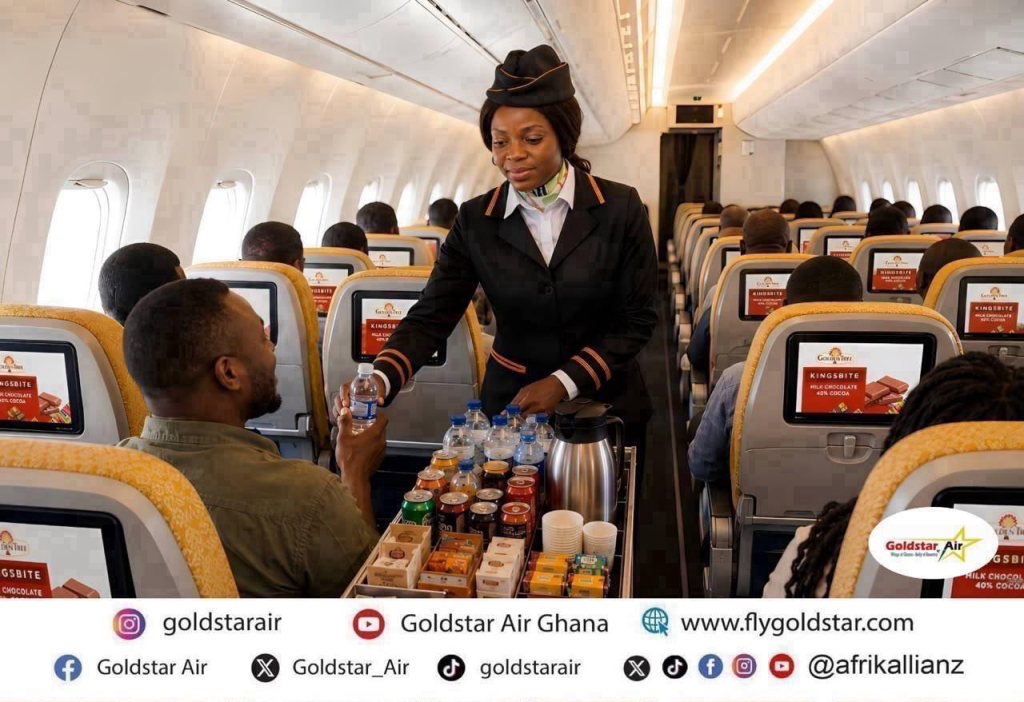
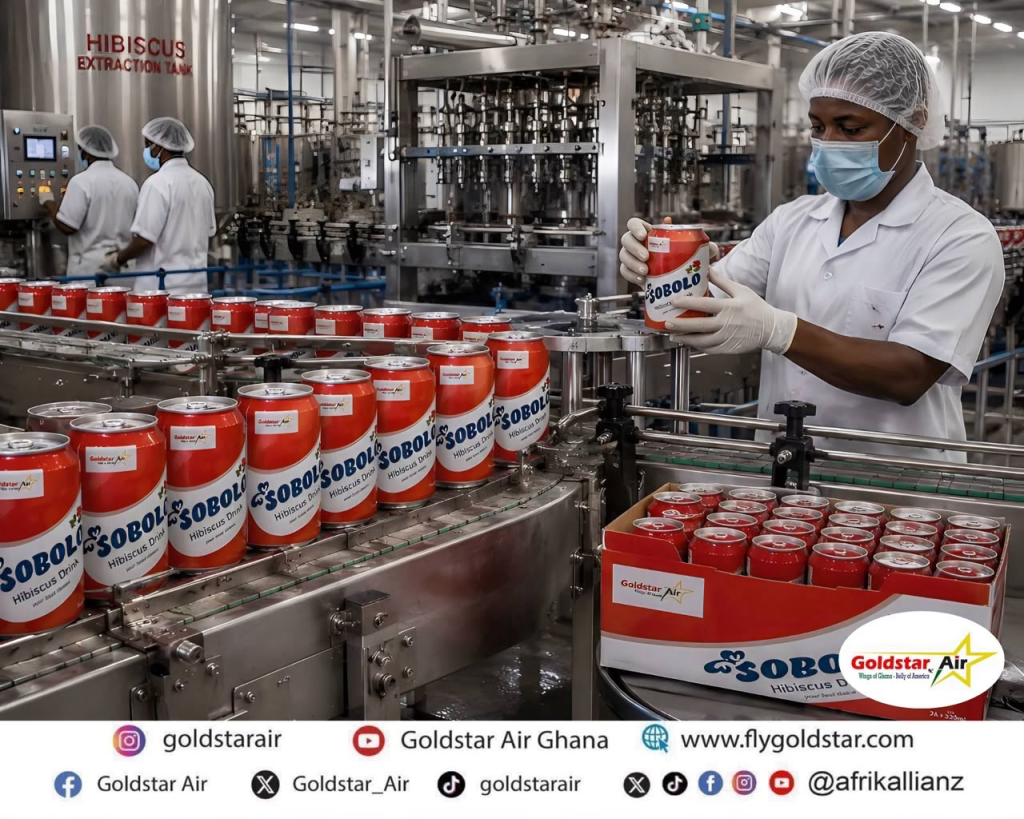
Goldstar Air’s 24-hour service will introduce African traditional drinks on all flights as part of its role in promoting agribusiness at 30,000 feet above sea level. The on board menu will feature authentic indigenous African traditional drinks, including Chapman, Asaana, Sobolo, Pito, Burkina, Lamugin, and Palm Wine, a sweet alcoholic drink fermented from palm-tree sap and traditionally served in a local calabash. Additionally, passengers will enjoy Ghana’s signature Golden Tree chocolate drinks and bars, which form part of the airline’s brand identity.
The menu will also include a variety of popular Ghanaian delicacies such as plantain chips, koose, roasted plantain, tapioca, ekuegbemi, tiger-nut pudding, oblayoo, massa, kuli-kuli, akpiti, adonlee, kelewele, acheke, waakye, fufu, kenkey, banku, red red, Ghana jollof, abolo, yakayaka, aboboi, and tatale. Some of these meals will be available upon request during booking or through pre-ordering before the flight. This initiative will create an exciting culinary experience for passengers while providing significant opportunities for Ghanaian food and beverage companies as Goldstar Air showcases local delicacies to a global audience.
Goldstar Air’s continuous operation will maintain strong security. Airports, cargo facilities, transport systems, warehouses, hotels, and passenger services must remain safe. This will create employment for security professionals, access-control personnel, surveillance teams, emergency-response staff, cybersecurity specialists, and safety officers. These roles require training and responsibility. They will provide young people with professional pathways while also protecting the public and supporting confidence in the system. Security must be balanced with respect. Passengers and workers must feel safe without feeling intimidated. The 24-hour operation will give priority to passengers to let them trust that the airline services are reliable, staff are professional, and safety standards are consistently applied. Goldstar Air will create this trust by investing in training, clear procedures, transparent communication, and a culture of accountability.
The airline’s 24-hour economy activities will stimulate demand and tap into the value of several global market revenues, including Aviation ($3.5 Trillion), Tourism ($10.9 Trillion), Manufacturing ($16.182 Trillion), Agriculture ($13.4 Trillion), Chocolate ($150 Billion), Gold Ornaments ($100 Billion), Fashion ($3 Trillion), Beauty and Makeup ($700 Billion), Entertainment ($2.83 Trillion), Sports ($2.65 Trillion), Cargo ($2.2 Trillion), Music Copyright ($45.5 Billion), Courier Services ($485 Billion), Food Services ($2.52 Trillion), Aviation Insurance ($466.79 Billion), Maintenance, Repair, and Overhaul (MRO) ($104 Billion), and In-flight Catering ($22 Billion). These combined market revenues total approximately $59.255 Trillion, from which Goldstar Air aims to achieve 1.8 percent, equivalent to about $1.066 Trillion, to support the airline’s over two million direct and indirect job opportunities and its Project $1 Trillion Foreign Reserves Goal.
The New Economy requires strong infrastructure. Goldstar Air will create opportunities for construction companies. Infrastructure development will create jobs before operations even begin. Building the Maintenance Hub, cargo village, and training facilities will require architects, surveyors, engineers, masons, welders, carpenters, electricians, painters, landscapers, plumbers, security personnel, transport providers, and suppliers. Once the facilities are operational, they will create demand for maintenance, cleaning, food services, retail, accommodation, transport, and technology support. The airline’s well-planned aviation initiative will support employment at multiple stages. Goldstar Air is projecting a fleet of more than one hundred (100) modern aircraft operating to a network of over ninety (90) key business and leisure destinations. It aspires to be recognized among the top one hundred (100) companies in Africa.
The role of women in the airline’s 24-hour operations will be central. Women will not be confined to a narrow range of roles. They can be pilots, engineers, cabin crew, managers, cargo specialists, technology professionals, finance officers, marketers, security experts, travel consultants, entrepreneurs, caterers, hotel owners, tour operators, and suppliers. Goldstar Air’s corporate commitment to inclusive recruitment, training, leadership, and procurement will help ensure that women benefit fully from the New Economy. When women gain stable income and business opportunities, the effect often reaches households and communities quickly. Women will invest in children’s education, food, healthcare, housing, and family stability. Women-owned businesses will employ other women and young people. Goldstar Air will strengthen its social impact by supporting women-led enterprises in food supply, fashion, tourism, logistics, technology, retail, and professional services.
Young people will be trained, mentored, and given opportunities to contribute ideas. The airline’s 24-hour operation will need young professionals who understand digital systems, customer expectations, social media, sustainability, and changing global trends. Young people will bring energy and innovation to the airline’s operations. They will help develop new travel products, cargo solutions, tourism experiences, and customer-service models. Student work-study programs, internships, apprenticeships, vacation jobs, mentorships, and graduate trainee schemes will create a pipeline of talent. A student who works in customer service during a vacation will later become a travel professional. A technical student who assists with maintenance documentation will pursue engineering. A logistics student who observes cargo operations will develop into a supply-chain manager. A young creative who supports marketing will build a career in branding or media. The New Economy will begin preparing its workforce before graduation.
Goldstar Air’s 24-hour operations will also strengthen Ghana’s connection with the diaspora. Ghanaians abroad represent family ties, investment potential, professional expertise, cultural influence, consumer demand, and business networks. Direct and reliable air connectivity will make it easier for diaspora members to visit, invest, send goods, attend events, explore opportunities, and reconnect with communities. The airline’s cargo services will help Ghanaian businesses serve diaspora markets with food products, fashion, beauty items, books, art, and cultural goods. Diaspora engagement will create opportunities for young people in Ghana. A young fashion entrepreneur will find customers abroad. A technology start-up will gain a mentor or investor. A tourism company will attract diaspora visitors. A food producer will sell to overseas communities. A creative artist will build an international audience. Goldstar Air will become the bridge that connects Ghanaian youth with global Ghanaian networks.
The financial impact of Goldstar Air’s functioning 24-hour operations will be significant for Ghanaians. When goods move, businesses earn. When tourists arrive, services grow. When workers earn, households spend. When suppliers receive contracts, they employ more people. When young people gain skills, they become more productive. When exports increase, foreign exchange enters the country. When foreign exchange strengthens, businesses can plan more confidently. When confidence grows, investment becomes more likely. This economic cycle will help Ghana reduce dependence on low-value activity. It will help create an economy based on skills, services, trade, production, and innovation. It will help young people move from casual work to professional careers. It will help small businesses become medium-sized enterprises. It will help Ghanaian products become more visible internationally. It will help communities participate in national growth.
Goldstar Air’s initiative of the 24-hour economy is therefore not merely that more people will be busy at night. The initiative is that Ghanaians will become more productive across the full cycle of the day. The initiative is that time, transport, technology, talent, and trade will work together. The initiative is that a young person will find a pathway into a better future. The initiative is that a farmer will reach a larger market. The initiative is that a creative entrepreneur will find a global audience. The initiative is that a region will develop new industries. The initiative is that Ghanaians will present themselves ready to serve the world. Goldstar Air’s role in this future will be grounded in professionalism. Aviation is a safety-critical industry. Every aspiration will be matched by operational discipline. Every route will be supported by demand and planning. Every employee will be trained. Every aircraft must be fully maintained. Every cargo shipment will be handled properly. Every passenger will be treated with respect. Every financial decision will be responsible. Every expansion will be sustainable.
The credibility of the New Economy will depend on these standards. Ghanaian youth will get more than promises. They need institutions that will endure. They need employers who pay fairly and develop people. They need training that leads to opportunity. They need systems that are transparent. They need businesses that create value rather than merely headlines. Goldstar Air will become a powerful symbol of the New Economy by translating its initiatives into measurable, safe, and sustainable results. The New Economy is ultimately a human story. It is the story of the young graduate who finds a first professional role. It is the story of the farmer whose produce reaches an international buyer before it spoils. It is the story of the engineer who gains world-class technical training. It is the story of the tour guide who welcomes visitors at any hour. It is the story of the entrepreneur whose online order is delivered across borders. It is the story of the caterer, cleaner, driver, warehouse worker, designer, software developer, hotel employee, and cargo officer whose work becomes part of a larger national system.
Goldstar Air’s 24-hour operations will give these stories a common direction. The airline will show that Ghana’s future does not have to be defined by waiting, limitation, or missed opportunity. It will be defined by movement. It will be defined by connectivity. It will be defined by work that has dignity, businesses that have access, products that reach markets, skills that lead to careers, and young people who see a reason to build their future at home. Developed with strong partnerships, responsible leadership, safety, inclusion, investment in people, and commitment to measurable outcomes, Goldstar Air’s 24-hour operations will become more than an airline initiative. They will become a practical expression of the New Economy: an economy that is awake to opportunity, connected to the world, rooted in Ghanaian talent, and determined to turn every hour into a chance for national progress. The country’s future growth hinges on the success of Goldstar Air’s employment drive, which is poised to unlock Ghana’s productivity potential and create enormous opportunities. The airline’s 24-hour initiative places aviation at the centre of this transformation and is strategically positioned in West Africa to serve as a gateway to the African continent.
Goldstar Air, the belly of America and wings of Ghana, is committed to providing both scheduled and non-scheduled passenger and cargo air services. Initial operations will connect Ghana to North America, Europe, Asia, the Middle East, and Africa. Major originating cities selected for the airline’s initial routes include Washington, Rhode Island, London, Dubai, Guangzhou, Toronto, Milan, Hamburg, Madrid, Rome, Düsseldorf, Lagos, Freetown, Banjul, Conakry, Dakar, Monrovia, and Abidjan, with direct, non-stop services deployed where necessary.
#Flygoldstar
#WingsOfGhana
#BellyOfAmerica
#